
 October 31, 2026
The Honest MOQ Conversation With a Filament Factory
A filament factory MOQ is two numbers, not one: the commercial tier and the custom-colour tier. This guide explains why minimums exist, the four levers a small brand actually has, and the five questions to ask before comparing quotes.
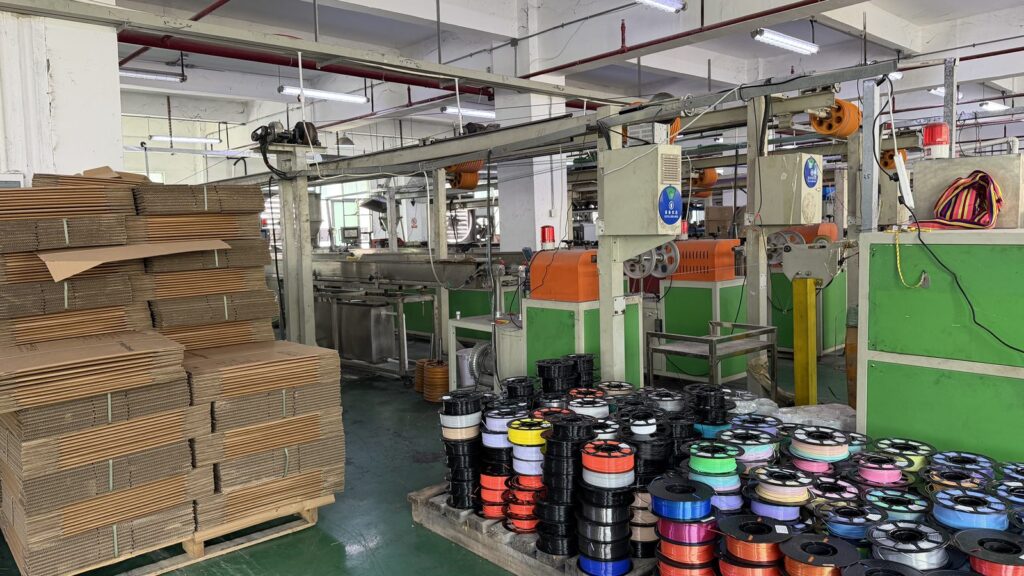
Most buyers treat MOQ as one number. It is not. You are really asking two questions: what is the standard commercial minimum, and what is the minimum to make the product fully yours? One number is for standard supply. The other is for a product shaped around your brand.
An honest factory conversation separates those two costs before you compare suppliers. FilaSource, the B2B filament brand of MUMAO Co., Ltd., sets the commercial order MOQ at 100+ spools, about 100 kg at 1 kg per spool. A custom-colour OEM reference line is roughly 3,000 kg. The rule I repeat most is: never compare one factory’s MOQ on EXW against another’s on DAP. Incoterms change what is included. Freight, insurance, and risk move with the shipping terms.
Table of Contents
Why does a filament factory have an MOQ at all?
An MOQ is not a punishment. It is the point where the order covers the factory’s cost of stopping one job and starting yours.
Every run on a filament line has three costs that do not shrink with order size. The first is changeover. A line must be cleaned, purged, and set for diameter, material, and colour. The second is batch control. A very short run still needs process checks, spool winding time, and packaging setup. The third is packaging. Cartons, spools, labels, and desiccant are ordered in fixed units. A small run can leave behind half-used boxes and awkward leftovers.
This is where buyers confuse physical carton size with commercial MOQ. A 10 kg carton is simply a box of ten 1 kg spools. It is not an order minimum. I see this mistake often in online answers. Someone reads “10 kg carton” and thinks the factory will sell one carton. That is like saying a bakery will sell you one loaf because the delivery crate holds twelve.
The commercial order minimum for our wholesale filament business is 100+ spools. That is roughly 100 kg. The factory can run a clean batch, pack full cartons, and avoid partial-box waste. It is also enough material to make quality control meaningful.
Practical rule: ask what the MOQ covers before you ask for a lower number. If a supplier cannot explain changeover, batch, or packaging cost, be careful.
What is the difference between a commercial MOQ and a custom-colour MOQ?
Standard colours are cheap because the factory can run them on normal schedules. Custom colours are expensive because they interrupt that schedule and leave behind material nobody else wants.
The commercial tier is easier to understand. You order from a stable supply list. PLA, PLA+, Matte PLA, and PETG are the products we can supply with dependable availability. You choose a standard colour and a standard spool. You meet the 100+ spool commercial MOQ. That is the wholesale filament path.
A custom-colour OEM path is different. Our reference line sits around 3,000 kg. That number is not a random gate. The factory has to match a colour, run proofing, dedicate machine time, and then manage leftover material. If the colour is wrong, the batch cannot just be sold as a standard shade. The cost of that risk is built into the minimum.
Some small brands are buying custom without realising it. If you put your own brand name on the spool, you are touching private-label territory. That is not always the same as custom colour, but it adds label plates, packaging files, and separate handling. You can see how private label filament works without assuming the colour itself is custom.
If you also change the colour or material, you enter custom filament development. That is where the big minimum comes from.
Practical rule: treat MOQ as two numbers. Ask which tier your specification falls into before you budget.
What levers does a small brand actually have?
A small brand cannot negotiate physics. But it can negotiate structure.
You do not have to beg for a lower number. You can change the order shape so the factory’s cost per kilogram falls naturally. Here are four levers that work better than pleading.
| Lever | How it works | What it costs you |
|---|---|---|
| Consolidate SKUs to reach the tier | Order fewer materials and fewer colours in one purchase | Less variety in your store at any one time |
| Stretch the resupply interval | Buy less often and hold more inventory in your own space | Cash tied up in stock and storage |
| Start from the stable supply list | Use PLA, PLA+, Matte PLA, and PETG for everyday orders; treat TPU, ASA, and ABS as per-project only | A narrower product range until volume grows |
| Use paid samples creditable to the first order | Test materials and finish before committing to the full MOQ; sample freight is usually buyer-paid but negotiable | Some sample cost and waiting time |
Stretching the resupply interval helps more than your warehouse plan. It also changes the factory’s cost per kilogram. Changeover and batch setup are fixed, so a 200-spool run spreads those costs over twice as many spools as a 100-spool run. The price per kilogram can move in your favour, even before any discount is discussed.
The first three levers move you closer to the commercial MOQ without changing the factory’s production economics. The fourth lever is a cheap entry, not a free trial. Our paid samples are creditable to the first order by written agreement.
Practical rule: before you ask for a discount, ask which lever your order can pull. You may find the commercial MOQ is closer than you thought.
What should you ask at quotation stage?
Quotes are only comparable when they describe the same thing. A minimum on EXW means something different from a minimum on DAP.
This is the exact conversation to have when a quotation lands. Five questions separate a clear supplier from a vague one.
- Which Incoterms basis does the MOQ assume? Compare every supplier under one basis. EXW means you collect and carry freight. DAP means the seller delivers to a named place. Use the ICC Incoterms rules as your reference. A lower MOQ on EXW is not automatically cheaper than a higher MOQ on DAP.
- Is the minimum per SKU, per colour, or per order? Some factories set the minimum across the whole order. Others set it per colour. This changes your purchasing plan completely.
- How does carton rounding work? Ten spools fill one 10 kg carton. Ask what happens if your order is 105 spools. Do you pay for an extra carton, or can one carton be split cleanly?
- What is the custom-colour threshold? Ask for the exact weight where a standard commercial order becomes a custom-colour OEM order. The number should be written, not guessed.
- What are the sample-credit terms? Confirm that paid samples are credited to the first order by written agreement. Also confirm who pays sample freight. Usually the buyer pays, but it is negotiable.
Ask for each answer as a quotation line. A clear line shows the Incoterm, the total weight, the SKU split, and the custom-colour threshold. If the answer only exists in a chat message, it is not ready to compare. Written terms are the ones you approve and hold a supplier to. A clear supplier will not hesitate to put the rule on paper.
Practical rule: put these five questions in one email before you request a lower MOQ. You will sound like a buyer who understands the factory floor.
True or False: MOQ beliefs
Many MOQ beliefs survive because nobody checks them. Here are three worth testing.
True or False: A 10 kg carton is the same as an MOQ.
False. A carton is ten spools. An MOQ is the minimum order the factory will accept. Confusing the two is one of the most common sourcing mistakes.
True or False: A custom colour is just standard filament with a different pigment.
False. It adds development, proofing, a dedicated run, and leftover material risk. That is why the custom-colour minimum is far higher.
True or False: A few hundred spools a month can work if I stay on the stable supply list and consolidate orders.
True. A few hundred spools a month is not impossible. The key is staying with PLA, PLA+, Matte PLA, or PETG and grouping orders to meet the commercial tier.
Practical rule: if a supplier’s answer to all three is “it depends,” ask for the tier table in writing.
FAQ
These are the questions buyers often ask after the first call. The answers are the same ones I give in plain language.
Is 100 kg a heavy order for a small brand?
It can feel heavy if you think in single spools. It is ten cartons. For a brand selling a few hundred spools a month, it is usually manageable when you consolidate SKUs.
Can I negotiate below the commercial MOQ?
You can ask. But treat any yes as a special condition, not the base price. A very small trial run may carry different terms and different cost per kilogram.
Does private label automatically mean custom colour?
No. Private label with a standard colour is different from a custom-colour OEM project. Ask the factory where your exact label and colour choice falls.
Do I need to pay for samples?
Yes. Paid samples are the norm. We credit sample cost to your first order by written agreement. Sample freight is usually buyer-paid, but negotiable.
Is the MOQ per order or per colour at FilaSource?
Ask for it in writing at quotation. Some suppliers set the minimum across the whole order. Others set it per colour. The quotation line should show which rule applies to your purchase. Do not rely on a chat answer. If the written line and the chat answer disagree, go with the written line.
Can I test a small batch before buying 100 kg?
Paid samples let you test material and finish before a full order. Some suppliers may also accept a small standard-colour trial, but that is a special condition. Ask for the trial terms and freight in writing before you plan around them.
Conclusion
An honest MOQ conversation ends with two numbers: standard commercial and custom colour. If the factory cannot explain why those numbers exist, keep looking. If they can, you have a supplier who thinks like a partner.
Tell us the material, volume, packaging and destination — we reply within 12 hours. Reference MOQ from 100+ spools (≈100 kg) for standard colors.
Discuss Your Project