
 October 26, 2026
ASA vs ABS: Which Filament Survives Outdoors?
ABS or ASA for outdoor parts? One difference decides most purchases: ASA survives sun, ABS yellows and embrittles. The honest comparison plus three supplier checks before buying in volume.
A part that lives outdoors breaks by a different clock than a part on a desk. Sun, rain and temperature swings eat materials slowly, then all at once — and the invoice for picking wrong arrives a year later, as warranty claims. ASA and ABS sit next to each other in most catalogues, cost about the same to buy in volume, and get chosen almost at random. That is a mistake worth fixing.
Here is the short version buyers actually need: ABS is the established workhorse with a deeper supplier base; ASA holds up outdoors in ways ABS simply does not. Everything else in this comparison is detail hanging off that one fork.
Table of Contents
- What Is the Real Difference Between ASA and ABS?
- Which One Survives Outdoors — and Which One Yellows?
- What Are ASA and ABS Each Best For?
- Can You Acetone-Smooth ASA Like ABS?
- What Does Printing Them Honestly Require?
- True or False: ASA vs ABS in Practice
- How Do You Buy Either One in Volume?
- FAQ
- Conclusion
What Is the Real Difference Between ASA and ABS?
Both are styrene-based engineering thermoplastics, both print hot, both want an enclosure — and buyers who stop at that sentence buy the wrong one. The table below is the comparison that matters. Both materials respond to acetone — ABS quickly and uniformly, ASA more slowly and with a less even finish.
| ASA | ABS | |
|---|---|---|
| UV / outdoor | Strong UV resistance | Yellows and embrittles outdoors |
| Typical use | Outdoor parts, automotive exterior, signage | Indoor enclosures, functional prototypes |
| Nozzle temp (typical) | ~235–260°C | ~230–255°C |
| Bed temp (typical) | ~90–110°C | ~90–110°C |
| Enclosure | Recommended | Recommended |
| Fumes | Ventilation needed | Ventilation needed (stronger odor) |
| Acetone smoothing | Yes — works, but slower and less uniform than ABS | Yes — the classic method |
| Relative cost | Usually slightly higher | Usually lower |
Temperatures are common industry starting ranges, not FilaSource test results. Always follow the TDS for your batch.
Which One Survives Outdoors — and Which One Yellows?
UV resistance decides this comparison. ASA holds up to UV exposure far better than ABS. Outdoors, ABS tends to yellow and become brittle. The chemistry reason is real but unhelpful at a desk — what matters is the failure you are buying insurance against: a bracket that has to survive three summers on a rooftop behaves completely differently in ABS versus ASA. Indoor enclosure, either works. Anything that sees weather, one of them works.
Buyers who skip this test pay for it twice: once in warranty replacements, once in reputation. A quick sanity check costs nothing — print the same part in both materials, leave one on a windowsill or a roof for a season, and compare color and toughness. Suppliers who claim “UV stable” should be able to describe the ageing conditions behind the claim, or send a sample so you can run your own.
What Are ASA and ABS Each Best For?
Print farms and workshops have settled this through use, not datasheets. ABS dominates where heat and post-processing matter — automotive interior fixtures, tooling, housings near warm components, and any part that will spend its life indoors but needs toughness and a mature supply chain. ASA takes the outdoor work: signage, garden equipment, electrical enclosures, drone bodies, anything mounted on a roof or a pole.

One practical wrinkle nobody mentions in catalogue copy: ABS is cheaper almost everywhere, and for indoor jobs the performance gap closes to zero. Paying ASA prices for a part that lives inside a cabinet is waste with extra steps. The reverse also holds — saving ASA money on a rooftop bracket is a warranty claim with a delay fuse.
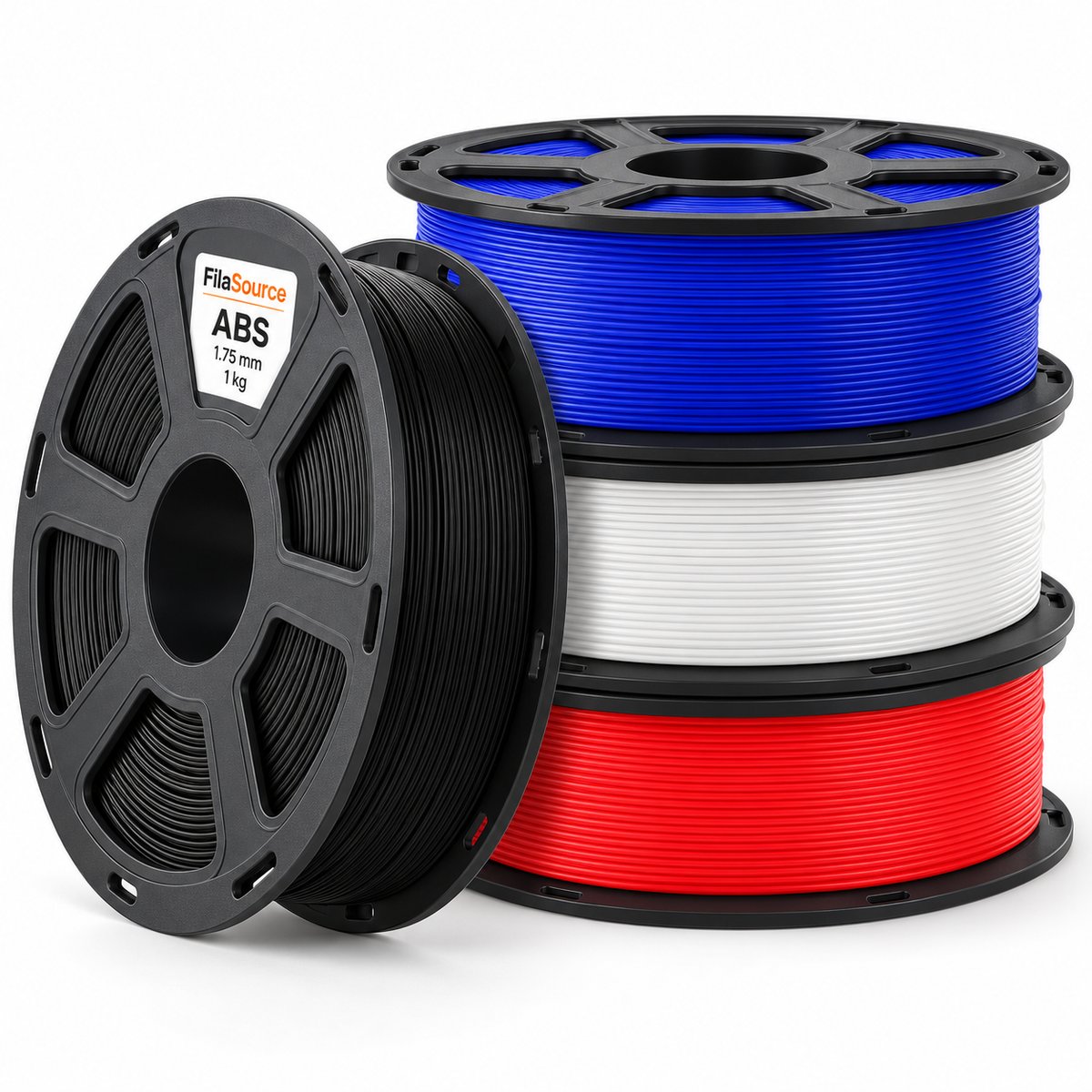
Can You Acetone-Smooth ASA Like ABS?
Yes — ASA dissolves in acetone too, so vapor smoothing works. It usually takes longer than ABS and the gloss can come out less even, so test on a scrap part with your exact grade and colour first. ABS remains the easier, more predictable choice when a smoothed finish is the main requirement.
What Does Printing Them Honestly Require?
Both are demanding printers compared to PLA. Heated beds matter, enclosures help, warping punishes the impatient. Print parameters for both are confirmed per project at FilaSource and shipped with the technical data sheet — blanket temperature numbers from a random forum post have cost more failed prints than any material defect ever will. Two honest processing notes:
- Warping: both materials warp without an enclosure. ASA is often slightly more forgiving, but large parts still need a heated chamber or enclosure and no drafts.
- Fumes: both benefit from ventilation; ABS styrene smell is the traditional complaint, ASA prints cleaner but is not fume-free.
True or False: ASA vs ABS in Practice
True or False: ASA and ABS cost about the same, so the choice is basically random.
False. Prices sit close together, but UV exposure splits the decision: outdoor parts belong in ASA, indoor parts save money in ABS.
True or False: Only ABS can be acetone-smoothed.
False. ASA also responds to acetone vapor; it is typically slower and less uniform, so test before committing a production finish.
True or False: For a part that lives inside a cabinet, ABS is usually the smarter buy.
True. Indoors the UV advantage is worthless, ABS is cheaper, and its supply base is deeper.
How Do You Buy Either One in Volume?
Three things to pin down with any supplier before money moves:
- Lot traceability. Ask how each batch is inspected and whether spools carry a lot ID you can quote back if a problem appears. If the answer is a friendly shrug, the next batch is a lottery.
- Actual outdoor data for ASA claims. “UV stable” on a label is marketing; ageing test conditions on request is a supplier.
- Sample first. Paid samples, same test print, your machine, your weather. The fee can be credited against a qualifying first order as agreed in writing.
Both materials are available from FilaSource in the wholesale programme at 1.75 mm (tolerance stated in the TDS): ASA here and ABS here. Reference MOQ from 50 kg for standard colours, confirmed per project; lead times are quoted after sample approval, not promised from a list price. Send material, volume, packaging and destination through the inquiry form — a real reply lands within 12 hours.
FAQ
Is ASA better than ABS for outdoor parts?
Yes, mainly for UV resistance. ASA keeps its colour and toughness in sunlight; ABS yellows and embrittles outdoors.
Do ASA and ABS need an enclosure?
Yes, for reliable results. Both warp without one; large parts need a heated chamber and no drafts.
Can ASA be acetone smoothed?
Yes. ASA dissolves in acetone and can be vapor-smoothed, though usually slower and less evenly than ABS. Test on a scrap part first; sanding and painting remain options.
Are ASA fumes safer than ABS?
Both need ventilation; do not assume either is safe to print in an unventilated room.
What is the MOQ for bulk ASA or ABS?
Reference MOQ: 50 kg standard colours, 500 kg custom packaging, 3,000 kg custom colours — confirmed per project.
Conclusion
Sunlight decides: ASA outdoors, ABS indoors. Both can be acetone-smoothed, ABS more predictably. Ask about lot traceability, request real UV data, and put a paid sample on record before the pallet ships.
Tell us the material, volume, packaging and destination — we reply within 12 hours. Reference MOQ from 100+ spools (≈100 kg) for standard colors.
Discuss Your Project